


It was just past 8am in Tylicz. The mountains were waking up with a beautiful sunrise. The kids were asleep in the next room, and I was standing there, admiring the view, waiting for the coffee to brew.
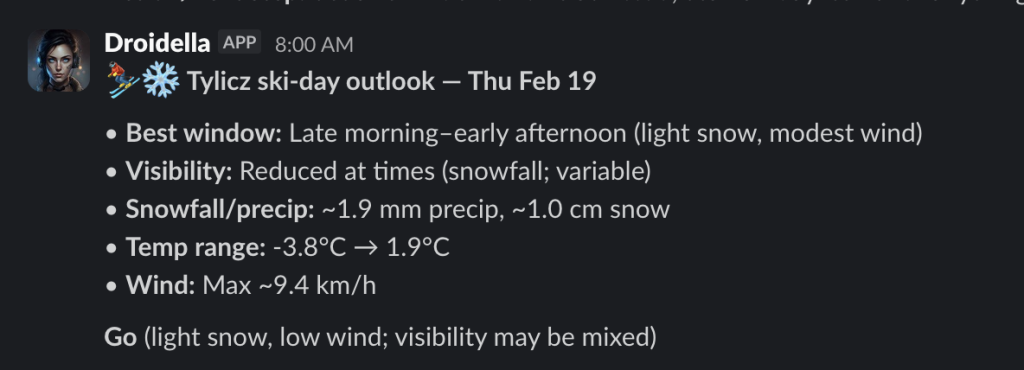
My phone buzzed. It was Droidella — my digital operator — with the morning digest.
Three sections. Clean, scannable, short.
First: the day’s intentions. What we wanted to do. Where we wanted to go. The small decisions that, on a ski holiday, determine how the whole day feels.
Second: ski weather report. Conditions at Master Ski, temperature, snow depth. Good. Fresh snow overnight.
Third: an ETA. Google Maps had already run the numbers, fourteen minutes from our place to the slopes, accounting for morning traffic on the mountain road. Pack the skis now, leave by 9:15, first lift by 9:30.
I poured the coffee. The logistics were already handled.
Getting there took longer than I expected. It started with a question I couldn’t answer, and ended with a travel memory system that now runs quietly in the background of every trip I take.
The Question I Couldn’t Answer
A few years ago, a friend asked me something simple: “That restaurant in Kraków you loved, what was it called again?”
I had no idea.
I remembered the meal. A long table, good wine, the city humming outside. I remembered going back a second time. But the name? Gone. Whether it was even still open? No clue.
I think of myself as a systems person. Files are organised. Projects are tracked. Decisions are documented.
But my travel memories? Scattered across old emails, photo captions, WhatsApp threads, and the gradually fading hard drive of my own brain.
That bothered me more than it should have. Because travel isn’t just logistics. It’s the raw material for future decisions. “Where should we go this summer?” “The kids loved that place in the mountains, should we go back?” Without a travel memory system behind those questions, every trip starts from zero. Same research. And same uncertainty. Same forgetting.
So I built one.
The Travel Memory System (Three Layers, Simpler Than It Sounds)
The concept is straightforward. Three types of notes, linked together.
Trip files are the containers. One file per trip: flights, accommodation, car rental, dates, costs, contacts. When I’m standing at an airport car rental desk and can’t remember the reservation number, I open the trip file. Three seconds.
City files are the living references. A note per city with coordinates, a one-liner, last visit date, and a rating. Every city file surfaces every trip that touched it, every meal worth remembering. Open Kraków and I see several years of visits, everything rated, annotated, linked.
Place files are the granular layer. The mountain café found by following hand-painted signs. The ski rental that lets you leave equipment overnight (genuinely useful with kids). Each place gets a note: type, description, rating, what made it worth remembering.
What links them is a geographic chain — a loc field mapping Places → Cities → Countries — plus wiki-links and embedded queries that automatically surface everything connected. Open any city file and you get every place visited there, every trip that passed through.
The result isn’t a scrapbook. It’s a queryable memory. “What have we eaten in Kraków?” takes seconds. “Which mountain resorts did the kids enjoy?” — instant filter.
The Backfill Project (The Part I Hadn’t Planned)
Once the travel memory system existed, I made the decision that turned out to be the most valuable part of the whole project: I went backwards.
Years of travel were buried in old emails, booking confirmations, Evernote exports, WhatsApp threads, and PDF attachments. Not lost — just inaccessible. No structure. No links. And no way to query any of it.
I started pulling it together. Exported Evernote notebooks. Searched Gmail for booking confirmations. Copied hotel emails. Downloaded PDFs from booking platforms I’d used years ago.
Then I fed it all to an AI assistant — in batches, with simple prompts: “Here’s a booking confirmation from 2019. Extract the flight numbers, hotel name, dates, and useful details. Format it as a structured trip note.” Then: “Here’s an old Evernote note about a restaurant in Vienna. Create a place file for it.”
What came out surprised me. Flights from 2019 with exact departure times. Hotels I’d genuinely forgotten I’d loved. A ski resort from 2018 with a note I’d written and completely forgotten: “kids’ slope perfect, hire shop opens at 7:30, coffee at the top is worth the extra lift.”
That note is now in my vault. Linked. Rated. Queryable.
The process took a weekend. Not a heroic, focused weekend, but a background weekend, running prompts while doing other things, reviewing output in batches. The AI did the extraction and formatting. I reviewed, corrected, and filed.
The goal wasn’t nostalgia. It was turning a decade of scattered signal into a planning asset. The travel memory system became a time machine for family decisions. Not just for what’s coming, but for everything we’d already done and half-forgotten.
What Happens When You Add a Digital Operator
The travel memory system solved the memory problem. But travel still had friction. Especially with kids.
Every trip brings cognitive load: different timezone, familiar routines breaking, more logistics, more decisions, less margin for error. I wanted to reduce that load without reducing the experience.
That’s where Droidella came in.
Droidella started as a podcast automation assistant; scheduling episodes, managing RSS feeds, handling the repetitive tasks I didn’t want to think about. Over time she became something broader: a single system where I route most of my recurring automation.
She lives in Slack. No dashboard. No special app. I send messages and get messages back.
The Poland trip was her first test in the field.
Seven Days in the Polish Mountains
Flight landed in Kraków at 11:25. Droidella flipped automatically to Polish time. All digests and schedules following local time from that moment. No manual adjustment. I just landed; she knew.
I picked up the VW Golf from Hertz at Balice, everything I needed was already in the trip file. Then drove 1.5 hours to Tylicz.
That first evening, I logged the taxi from London through Slack. Two lines. Droidella formatted it and added it to the trip file’s costs table. £88 (ouch). Filed.
Each morning after that, the digest arrived before the kids woke up. Day’s intentions. Ski conditions. ETA to the slopes. The first decision of the day, already answered. I’d read it over coffee, get the kids up, and we’d leave knowing exactly when.
Day two: kids’ first ski lesson with the instructor. I watched them from the bottom of the slope, this anxious, uncertain shuffle becoming something more deliberate over two hours. That evening I logged a journal entry through Slack. A few lines. Droidella formatted it and filed it.
On day four, my daughter had a run where she stopped being afraid and just went, arms out, proper speed, no hesitation. I wasn’t thinking about logistics. I was just there.
Mid-trip, we used Droidella’s utility tools a few times — find a café in the village open now, how long to drive to the Jaworzyna Krynicka gondola. Quick asks, quick answers. No app-hopping.
By the time we drove back to Kraków airport, seven days of logistics were captured without any post-trip admin. The costs table was complete. Not reconstructed from memory or credit card statements. The journal had seven entries. The places we’d discovered were filed and rated, and the travel memory system was seven days richer.
What Worked, and What Didn’t
The timezone flip was invisible and essential, routines just continued, correctly. The morning digest was useful every single day. The costs tracker turned something I’d always dreaded into a two-minute evening habit. The on-the-go tools saved real decisions in real moments.
The rough edges were real too.
Droidella has a deliberately minimal digital footprint — separate email, separate handles — to keep the blast radius small if something goes wrong. That setup was careful and slow. Worth it long-term, but not effortless.
And Slack dependency meant no signal meant no Droidella. In the mountains, connectivity was occasionally the bottleneck. On the days we were deep in the hills, I was back to figuring things out manually.
The honest conclusion: a reliable system that stays quiet when you don’t need it and shows up when you do beats a sophisticated one that demands attention.
Lessons Learned From This Coffee Journey
Travel, like a good cup of coffee, is best when you’re actually there for it. The whole point of building this travel memory system wasn’t to optimise the trip. It was to be present for it.
Here’s what I took away:
- Structure before automation. The travel memory system had to exist first. Droidella couldn’t file trip costs to a trip file that didn’t exist. Build the foundation before adding intelligence on top.
- Low noise is a feature, not a compromise. The morning digest worked because it was short. Three sections, scanned in 30 seconds. More would have meant less.
- Capture daily or reconstruct forever. The costs tracker and journal worked because the habit was daily and frictionless. A post-trip reconstruction would have been a chore — and half of it would have been wrong.
- The backfill is worth doing. I resisted it for years — felt like admin for admin’s sake. But a decade of historic trips, rebuilt and queryable, is now a planning asset. Next summer, when we’re choosing where to take the kids, I have seven years of rated, annotated, linked data to draw on.
What the System Actually Gave Me
The combination:
- A travel memory system (the notes vault)
- A digital operator (Droidella)
- One interface (Slack)
…meant that during seven days of family skiing in southern Poland, I spent almost no time on logistics.
Which meant I was there for the run where my daughter stopped being afraid.
I’m still refining both systems. There are things I’d add to Trip Mode. There are gaps in the travel memory system I want to close. But the core is solid — and it changes how travel feels. Lighter. More present.
If you’ve built something similar — or if you’re still figuring out how to stop losing your best travel memories — I’d love to hear about it. Drop a comment, or reply if you’re reading this in the newsletter.
If you found this useful, I’d genuinely appreciate you sharing it with someone who might enjoy it. That’s how Coffee Journeys grows — one thoughtful reader at a time.
This is fascinating! I especially appreciate how you’ve linked trips, cities, and places – it sounds like a much more intuitive and connected way to store travel memories than just chronological photos. I’m curious to know more about which tools you found most helpful for building your digital operator.
Pingback: Magiz