

Leadership is never one-size-fits-all. What works in one moment may fail in the next, even with the same person. On a recent family holiday, I learned this lesson firsthand — not in a classroom, but in a tent and on a train. It turned out to be the perfect case study for Situational Leadership® (SLII®), a framework that teaches leaders how to flex their style to match competence and confidence.
For the third summer in a row, we packed our bags for Poland. The plan was simple: enjoy family time, slow down, and reflect on the past few months. Oh, and celebrate a personal 5.0 upgrade (more on this in my newsletter here).
On paper, it was meant to be quiet. But if you know me, you know I can’t quite switch off. This year my backpack was full of fresh ideas: two recent courses on AI and one on leadership. And those ideas didn’t stay in the classroom for long. They came alive sooner than I expected.
For the first time, we went camping with our kids. A proper adventure, definitely outside our comfort zone. To be fair, it was just one night at a very friendly base camp, but still… we packed tight: tent, sleeping bags, and far too many snacks. The kids were buzzing.
🏕️ Competence And Confidence In Action
An hour later, the buzz had fizzled into frustration. Tent poles everywhere, no one sure what went where, and plenty of “Dad, are we nearly done yet?” moments. As I fumbled with the poles, it hit me: this was new for all of us. And fresh in my mind was a concept from my recent course, Situational Leadership (SLII®).
We were enthusiastic beginners. A textbook D1 moment: high energy, low experience. My role? Be clear, patient, and give step-by-step guidance. We managed it and even enjoyed our one night of voluntary discomfort.
A few days later, the picture was very different. In Slovakia, we boarded the Tatra Electric Railway. My son, who already navigates London’s Tube with ease, stepped straight into action. He asked whether we had tickets ready or if we’d downloaded the app, quickly spotted great seats, saved them for the whole family, and guided us confidently into place.
Same child, same trip, but this time operating at a D4 level: capable, confident, and only needing a little encouragement from the sidelines.
And that’s the part of SLII® that really stayed with me: the same person can be D1 in one situation and D4 in another. It all depends on the task, the moment, and the context. That single idea reframed how I see both leadership at work and parenting at home.
Leadership isn’t something we do on people. It’s something we do with people.
🧠 What is Situational Leadership and Why Does it Matter?
Created by Ken Blanchard, Pat Zigarmi, Drea Zigarmi, and Victoria Halsey, Situational Leadership is one of the most widely recognised leadership frameworks in the world.
At its core is a simple truth:
👉 Leadership isn’t something you do to people, it’s something you do with people.
Too often, we fall into “one-size-fits-all” leadership. But SLII® shows us how to flex and match our style to someone’s needs in the moment, based on their competence and confidence.
🎯 The Three Essential Skills of SLII® for Competence and Confidence
SLII® rests on three practical skills that any leader can apply:
- Goal Setting
- Agree what needs to be done, and by when.
- Use SMART goals: Specific, Motivating, Attainable, Relevant, Trackable.
- Specific and Trackable are written down; the others are part of the conversation.
- Diagnosing
- Work with someone to assess their competence and confidence on a given task.
- Competence = skills and knowledge.
- Confidence = motivation and belief in their ability.
- Remember: development is task-specific. Someone may be a D4 expert in one area and a D1 beginner in another.
- Matching
- Adjust your leadership style to fit.
- There’s no “best” style, just the one that matches the person’s competence and confidence in that moment.
📈 The Four Development Levels (D1–D4)
People typically sit in one of four stages:
- D1: Enthusiastic Beginner
Excited but inexperienced. Needs direction, clarity, and feedback. - D2: Disillusioned Learner
Some skills but struggling. Needs patience, explanations, and encouragement. - D3: Capable but Cautious Contributor
Has the skills but not always the confidence. Needs involvement and reassurance. - D4: Self-Reliant Achiever
Skilled, confident, and trusted. Needs autonomy, trust, and recognition.
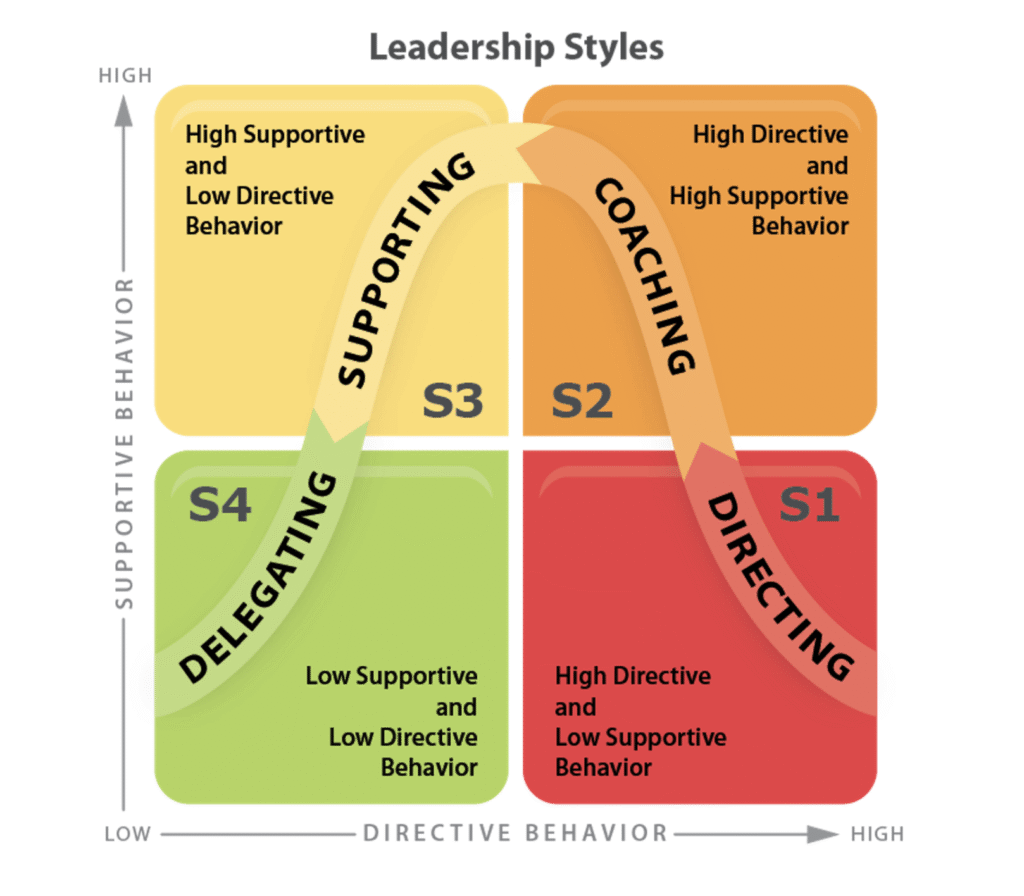
🌱 The Four Leadership Styles (S1–S4)
SLII® combines directive behaviours (telling what, how, when) with supportive behaviours (listening, encouraging, explaining why).
- S1: Directing (High Direction, Low Support) → for D1
Leader says: “I’ll decide.” - S2: Coaching (High Direction, High Support) → for D2
Leader says: “Let’s talk, I’ll decide.” - S3: Supporting (Low Direction, High Support) → for D3
Leader says: “Let’s talk, you decide.” - S4: Delegating (Low Direction, Low Support) → for D4
Leader says: “You decide.”
Across all four, the leader’s role is to stay connected, set goals, and give feedback based on competence and confidence.
↔️ Why Matching Matters
When leaders flex their style to someone’s competence and confidence, three powerful things happen:
- People feel respected and supported.
- They take ownership of their growth.
- Trust deepens, and performance improves.
And ultimately, the goal is simple: to help people grow into self-reliant achievers.
🛠️ Tools and Concepts That Make It Practical
In the SLII® framework, competence and confidence are central to employee development.
- Competence is about skill and ability. It reflects how capable someone is in terms of knowledge, skills, and experience related to the task at hand.
- Confidence is about self-belief. It reflects motivation, assurance, and the readiness to take initiative and make decisions.
SLII® is designed to help people grow in both competence and confidence. And here’s the important part: it’s not something you do to people, it’s something you do with people. Leaders use the three core skills of Goal Setting, Diagnosing, and Matching to assess and respond to these two dimensions. The aim is always to support individuals in building autonomy and self-reliance.
To make this practical, SLII® also offers simple tools:
- One-to-one worksheets: team members assess their own competence and confidence, then request the leadership style they need.
- Conversation starters: prompts that make it easier for leaders and team members to talk openly about support.
- Manager toolkits: weekly summaries and reminders to help leaders keep flexing their style.
🎓 Lessons Learned From This Coffee Journey
- Leadership isn’t fixed, it shifts with the situation.
- The same person may be D1 in one task and D4 in another.
- Matching style to someone’s competence and confidence is the heart of growth, for both leader and team.
- Asking “what’s their competence and confidence here?” is a powerful leadership habit.
- True leadership is done with people, not on people.
That’s why I keep thinking back to our holiday. One night in a tent, one ride on a train. Two very different situations, two very different leadership styles, and one simple framework that made sense of it all.
Thanks for reading!
If you enjoyed this article, feel free to share it on social media and spread some positivity, and join my newsletter.