
Contents ☕
In 2020, the year this blog got going, I took two writing courses on Udemy. One was about editing: how to make a piece better at every level, from the story down to the single word. The other was about the system: how to keep writing every week without running out of ideas.
Six years and well over a hundred posts, newsletters and Now pages later, both still show in how I write.
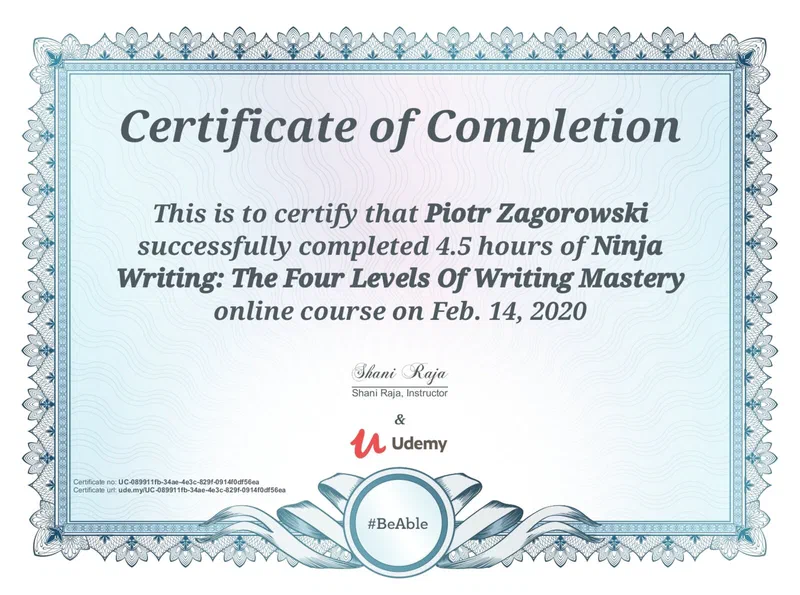
| Ninja Writing: The Four Levels of Writing Mastery | Shani Raja (ex-Wall Street Journal editor), Udemy, 4.5 hours. Completed 14 February 2020. Verify |
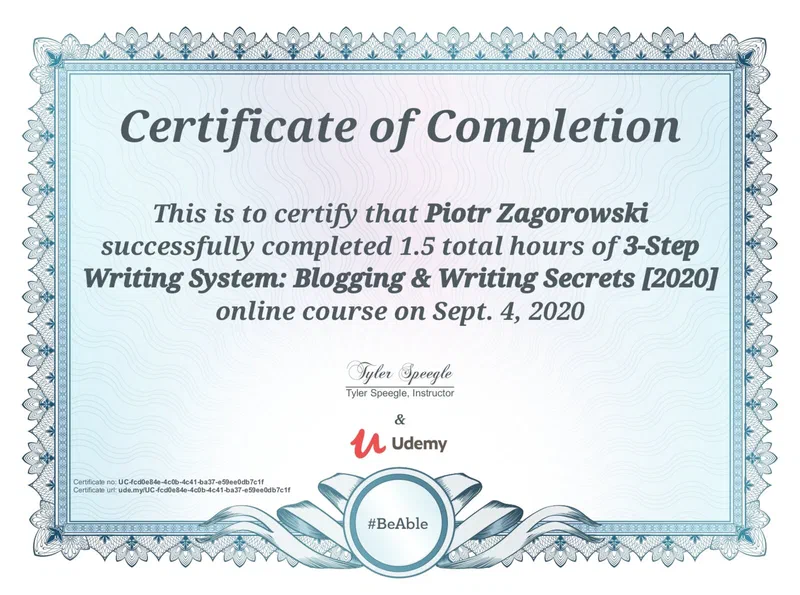
| 3-Step Writing System: Blogging & Writing Secrets | Tyler Speegle, Udemy, 1.5 hours. Completed 4 September 2020. Verify |
Four levels: story, paragraph, sentence, word
Shani Raja teaches editing at four levels:
- Narrative: the structure. Connect with your reader, start strongly, end cleanly.
- Paragraph: one point per paragraph, woven so the whole piece feels ordered.
- Sentence: turn limp, bloated sentences into sharp, rhythmic ones.
- Word: choose precise words, and strip out any that carry dead weight.
The useful part is the order. Fix the story before you polish a sentence, and polish sentences before you argue about a word.
You can see the narrative level in every post on this blog: a short opening, sections you can scan, a “Lessons Learned From This Coffee Journey” list near the end, and a question to the reader to close. That shape follows Shani’s advice to start with a bang and end with a flourish. At the word level, I keep a list of words I don’t let into my newsletter: the overused ones that sound important and say nothing.
A system for writing every week
Tyler Speegle’s course is about the process around the writing: keep ideas flowing so you never run out, organise them, write headlines that earn the click, open strongly, revise, and make each post easy to scan.
The part that lasted is the idea pipeline. I capture every idea as a one-liner, the moment it comes. The ones that keep pulling at me grow into full notes with the story, the sources and a few possible angles. Only then does one become a post, a newsletter or a Now page. I rebuilt that pipeline in Obsidian when I moved my notes from Evernote, but the principle is the one this course taught: never start writing from an empty page.
Who it’s for
Engineers and leaders who write more than they think: emails, design docs, status updates. Better writing makes all of them shorter. For the structure of a single message, see BLUF and PREP.
Lessons Learned From This Coffee Journey
- Edit in order: story, paragraph, sentence, word.
- One point per paragraph.
- Keep a list of the words you overuse, and cut them.
- Capture ideas as they come, so you never start from an empty page.
- A recognisable shape helps readers: they know where to find the point.
My certificates
This is one of the courses I recommend for growing your career. What’s the one writing habit that made the biggest difference for you? Tell me.