Contents ☕
I’ve written a lot on this blog about productivity: routines, why time management is a myth, and a whole series of frameworks. Two short courses from late 2019 sit underneath much of it: one about running my days, one about setting goals that mean something.
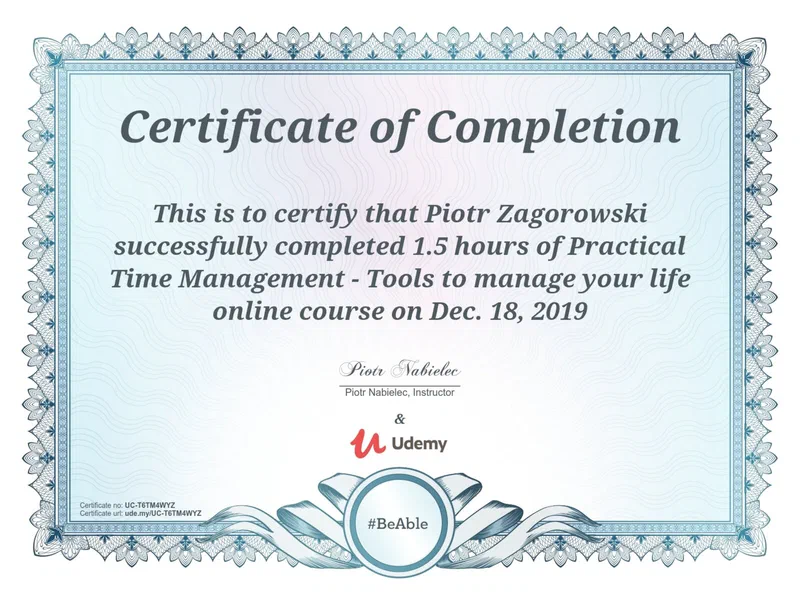
| Practical Time Management: Personal Productivity Tools | Piotr Nabielec, Udemy, 1.5 hours. Completed 18 December 2019. Verify |
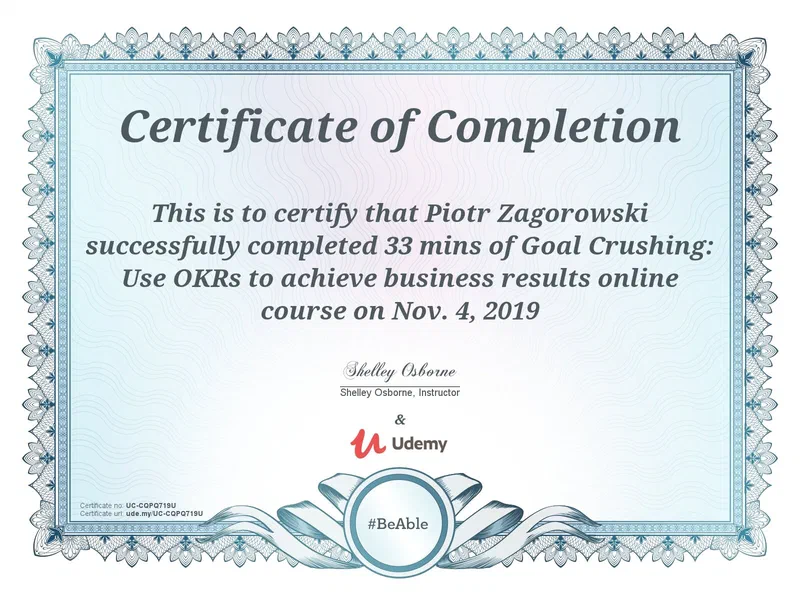
| Goal Crushing: Use OKRs to Achieve Business Results | Shelley Osborne, Udemy, 33 minutes. Completed 4 November 2019. Verify |
Work with your brain, not against it
Piotr Nabielec’s course starts with the limits of the brain and how to cooperate with them. Then it covers task lists, calendar management, protecting focus, and the essence of about 40 books (Getting Things Done, The Power of Habit, Essentialism) tested over ten years with more than 2,000 people.
What I took from it most was habits. A couple of weeks after finishing it, I wrote Is Routine Good for You?, and the course is the one I recommended there for building healthy habits. The idea that stayed: our brain automates as much as it can, so we all run on routines, whether we chose them or not. The job is to choose them on purpose, and to do a “routine inventory” every so often: drop the habits that no longer serve you and swap in ones that fit your new goals. An annual review is a good moment for it.
The other lesson grew over the years into Productivity: Buzzwords, Myths and Traps: tools help, but systems and habits are what make the difference. Being busy isn’t the same as being productive.
OKRs: write the result, not the activity
Shelley Osborne’s course is short, and it’s about writing objectives and key results that show the value of your work. My notes on it boil down to a few rules:
An objective answers “where do we need to go?”
- It isn’t measurable on its own. It’s the direction, and it should be inspiring.
- It moves the company forward and is time-bound: annual, broken into quarters.
- It shouldn’t be easy. If you hit every objective, you aimed too low; about two-thirds is a good result.
- It isn’t a project with subtasks.
A key result answers “how do we know we’re getting there?”
- It’s specific, quantifiable, and ambitious but achievable.
- It allows objective grading.
- It’s never binary, and never a task. For example, “Launch the dashboard” is a task. “Cut the time to answer a customer request from five days to two” is a key result.
OKRs and KPIs are not the same thing
Later I added one more distinction that the course only touches on. OKRs are a goal-setting system: they define change. KPIs are metrics: they watch the health of business as usual. Most teams need both, and they feed each other: pick three to five KPIs that show your team is healthy, and three to five quarterly objectives for what should be different.
The Duke programme page has my story of a KPI that worked: a target of 1,000 peering connections.
Who it’s for
People who feel busy but not effective. Start with Nabielec’s course if your days run you; start with OKRs if your team can’t explain why its work matters. Nabielec’s course also exists in Polish.
Lessons Learned From This Coffee Journey
- We all run on routines. Choose yours on purpose, and review them every year.
- Tools help; systems and habits make the difference.
- Key results measure outcomes, not tasks.
- If you hit every objective, you aimed too low.
- OKRs for change, KPIs for health.
My certificates
This is one of the courses I recommend for growing your career. Which do you need more right now: better days or clearer goals? Tell me.