
Contents ☕
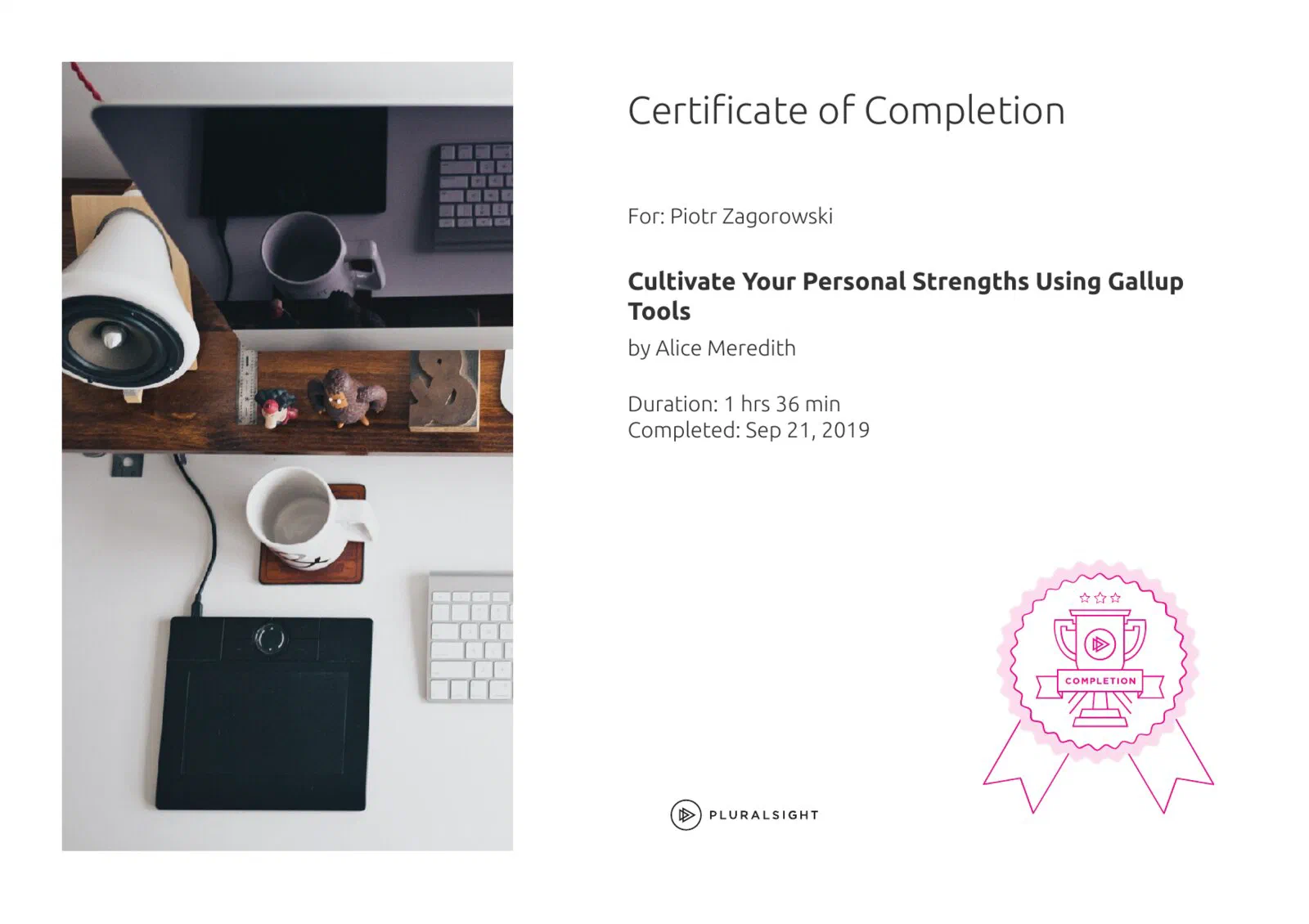
In 2019 I took Alice Meredith’s Cultivate Your Personal Strengths Using Gallup Tools on Pluralsight. I’d first taken the CliftonStrengths assessment back in 2013, and the report had mostly sat in a drawer since. The course is an hour and a half long, and it changed how I think about my own development: stop trying to fix every weakness, and get much better at using what’s already strong.
My top five CliftonStrengths are Relator, Arranger, Discipline, Harmony and Individualisation. Here’s what each looks like on a good day and a bad one: the balcony and the basement.
| Course | Cultivate Your Personal Strengths Using Gallup Tools |
| Instructor | Alice Meredith, Pluralsight |
| Length | 1 hour 36 minutes |
| Completed | 21 September 2019 (CliftonStrengths assessment first taken in 2013) |
Strengths first, weaknesses second
The course has two simple rules:
- Maximise your strengths. Understand how they show up in your day, choose work that uses them, and practise them on purpose.
- Work around weak themes. Just get a little better at them, surround yourself with people whose strengths cover yours, and set reminders for the things you’d otherwise miss.
The second rule was a relief. I didn’t have to become good at everything.
My top five: balcony and basement
Every strength has a balcony, what it looks like at its best, and a basement, what it looks like when you overuse it. The basement is the part worth knowing.
Relator
Close, caring, trusting relationships; a small circle of people I’d do anything for.
- Balcony: forgiving, caring, deep one-to-ones.
- Basement: prone to cliques, may favour people I know, may fail to network.
Arranger
Organising people and resources for the best result, and staying flexible when things change.
- Balcony: I can get a complex project moving.
- Basement: I keep seeing ways to improve the plan. That can mean reorganising things that were already working, or spending too long optimising the coordination instead of deciding and moving on.
Discipline
Routine, structure, finishing what we started.
- Balcony: things get done.
- Basement: frustration when others are less organised or don’t follow through. I can become too focused on process, structure or predictability when flexibility would help.
Harmony
Looking for common ground and understanding others.
- Balcony: calm in conflict; people feel heard.
- Basement: avoiding difficult conversations, or delaying a necessary disagreement, because keeping the relationship feels more important than creating tension.
Individualisation
Noticing what’s unique about each person and treating them that way.
- Balcony: a good team builder, with custom-made relationships.
- Basement: I can hesitate to apply the same standard, process or message to everyone, because I’m focused on individual circumstances and exceptions.
When the basement showed up: Harmony and Relator
When I lead cross-functional work, I put a lot of effort into building alignment and making sure everyone feels heard. It builds strong partnerships. But there have been times when I delayed pushing for a decision because I wanted broader agreement first.
Looking back, a quicker escalation or a more direct challenge would have moved the work forward faster. Harmony wanted everyone on board; Relator didn’t want to strain the relationships I’d built. Both are strengths. Together, overused, they cost time.
My other two basements are quieter. Arranger and Discipline together make me keep refining the plan and the process, which raises the odds of success but sometimes means I optimise the execution instead of simplifying the problem. And Individualisation can make me accommodate one person’s circumstances when a consistent expectation would be clearer and fairer for the whole team.
How I use them now
In interviews, I use my strengths to describe how I work, rather than the adjectives everyone uses. Relator for building one-to-ones, Arranger for making things effective, Discipline for finishing, Harmony for finding common ground, Individualisation for treating each person differently. It sounds more honest, because it is.
Individualisation is also why SLII clicked for me: different people need different leadership, even on the same day. You can see how my strengths fit the rest of me on my About page.
Who it’s for
Anyone who has done the CliftonStrengths assessment and filed the report away. The course turns the report into something you use. If you haven’t done the assessment, do that first.
Lessons Learned From This Coffee Journey
- Get better at what you’re good at before you fix what you’re not.
- Know the basement of every strength.
- Two strengths can share a basement. Watch the combinations.
- Surround yourself with people whose strengths cover your weak themes.
- Describe yourself with your strengths, not with buzzwords.
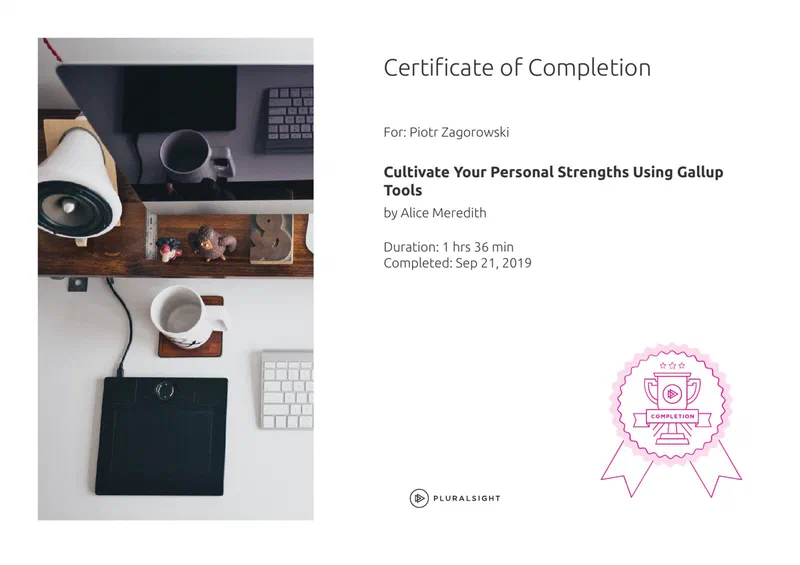
My certificate
This is one of the courses I recommend for growing your career. What’s your top strength, and what does its basement look like? Tell me.