
Contents ☕
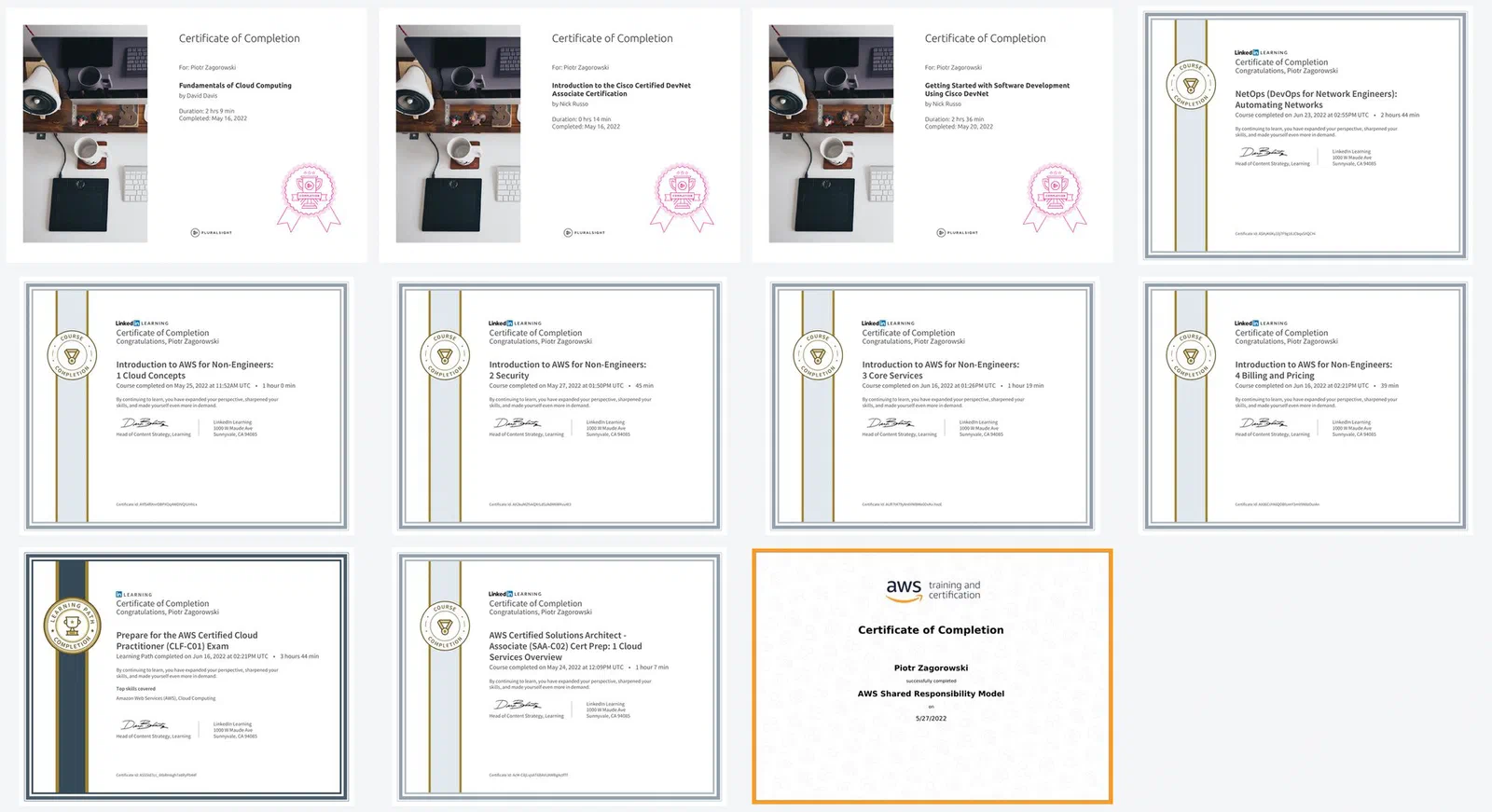
I started as a network engineer. Over the years, leadership took more and more of my week, and the hands-on part of my job took less. In May and June 2022, a few months before I left Cisco after 14 years, I took a burst of courses on cloud and network automation: eleven certificates in six weeks.
This page is the map I wish I’d had: what each course covers, and what I took from it.
| Course | Instructor and platform | Completed |
|---|---|---|
| Fundamentals of Cloud Computing | David Davis, Pluralsight | 16 May 2022 |
| Introduction to the Cisco Certified DevNet Associate Certification | Nick Russo, Pluralsight | 16 May 2022 |
| Getting Started with Software Development Using Cisco DevNet | Nick Russo, Pluralsight | 20 May 2022 |
| AWS Certified Solutions Architect Associate (SAA-C02) Cert Prep: 1 Cloud Services Overview | LinkedIn Learning | 24 May 2022 |
| Introduction to AWS for Non-Engineers, parts 1 to 4 | LinkedIn Learning | 25 May to 16 June 2022 |
| AWS Shared Responsibility Model | AWS Training and Certification | 27 May 2022 |
| Prepare for the AWS Certified Cloud Practitioner (CLF-C01) Exam, learning path | LinkedIn Learning | 16 June 2022 |
| NetOps (DevOps for Network Engineers): Automating Networks | LinkedIn Learning | 23 June 2022 |
Cloud fundamentals for people who run networks
David Davis’s Fundamentals of Cloud Computing is the plain-language start: what IaaS, PaaS and SaaS are, how networking, storage and security work in the cloud, and how they compare.
The AWS courses then made it concrete. The list I kept from Cloud Concepts is the cloud’s whole sales pitch in six lines:
- Trade capital expense for variable expense.
- Benefit from massive economies of scale.
- Stop guessing capacity.
- Increase speed and agility.
- Stop spending money running and maintaining data centres.
- Go global in minutes.
Two ideas mattered most to me as someone who leads technical teams:
- The shared responsibility model. AWS is responsible for security of the cloud; you’re responsible for security in the cloud. Knowing where that line sits is half of cloud security.
- Billing is part of the architecture. You pay for compute, storage and data going out, and the more you use, the cheaper each unit gets. Cost is a design decision, not something finance discovers at the end of the month.
A note I saved later lists the stages of learning AWS by doing: spin up a server, break it, fix it, add a load balancer, then auto scaling, queues, storage, managed databases, monitoring, VPCs and Terraform. Its last stage, half a joke, is to stop paying huge bills and run your own VPS. Years later, that’s what I did with this blog.
From CLI to API
Nick Russo’s DevNet courses teach the basics a network engineer needs to start automating: the foundations of software design, structured data, local version control with Git, basic GitHub repositories, APIs, and Python’s requests library. The introduction is only 14 minutes long and explains who the DevNet Associate exam is for, and the learning path that leads to it.
His curated course list is still the best starting map I know for network automation.
NetOps (DevOps for Network Engineers) closes the loop: what changes when you treat network changes the way developers treat code.
What it changed
Courses like these don’t make you a cloud architect, and they aren’t meant to. What they give you is the vocabulary and the mental model to lead technical work without bluffing: to ask a team the right question about cost, security or automation, and to understand the answer.
My work now is customer-facing APIs and networking infrastructure, and these courses were part of the step from network engineer to someone who builds with APIs, and later with AI. For the hands-on side of that today, see how I built a home lab for local LLMs.
Who it’s for
Network engineers who keep hearing “automate it” and don’t know where to start, and leaders of infrastructure teams who need to speak cloud.
Lessons Learned From This Coffee Journey
- Security of the cloud is the provider’s job; security in the cloud is yours.
- Billing is architecture. Learn how you’re charged before you build.
- Network automation starts with structured data, Git and APIs, not with a tool.
- Leaders don’t need to be experts, but they need enough vocabulary to ask good questions.
My certificates
This is one of the courses I recommend for growing your career. Which technical skill would you learn again if you moved into leadership tomorrow? Tell me.