
Contents ☕
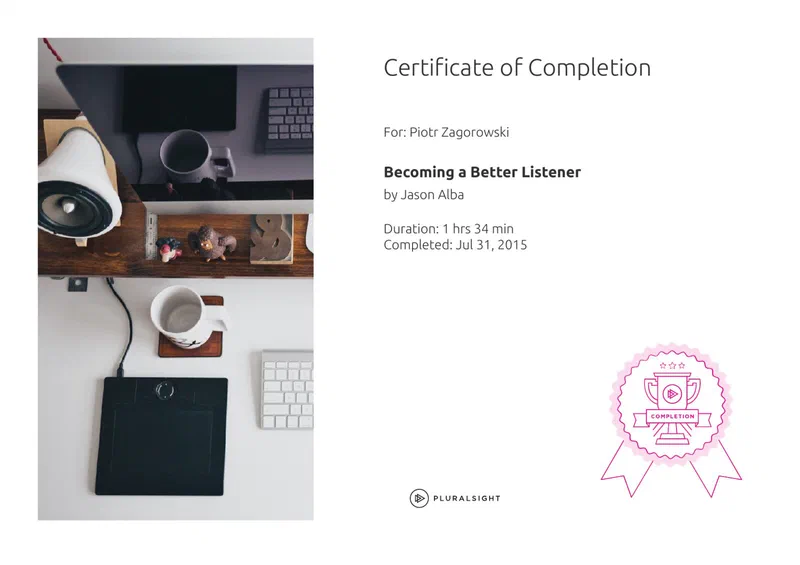
Most people who think they’re good listeners aren’t. I was one of them. In 2015 I took Jason Alba’s Becoming a Better Listener on Pluralsight, an hour and a half long. Ten years and a podcast later, it’s one of the courses I come back to most.
| Course | Becoming a Better Listener |
| Instructor | Jason Alba, Pluralsight |
| Length | 1 hour 34 minutes |
| Completed | 31 July 2015 |
Active or passive?
The course starts with a simple check. Active listening looks like this: engaged body language, eye contact, short responses, clarifying questions, patience. Passive listening looks like this: one eye on email, “um-hm”, asking people to repeat themselves, waiting for your turn to talk.
I recognised the second list more than I wanted to.
Listen as if you’ll have to teach it
The tip that stuck: listen as if you’ll have to teach the conversation to someone else afterwards. It changes how you listen. You stop preparing your answer and start collecting the points.
Also: listen with your eyes. And a line I’ve used in negotiations since: “He who talks first loses.”
The personal debrief
After an important conversation, write down five things:
- A summary of the conversation.
- What did you learn?
- What do you think about it?
- What would you do differently?
- What do you need to follow up on?
I still use it at work. But these days I use it most often on the mats. Once a week I train Brazilian jiu-jitsu with my son, and afterwards I use the debrief, or a few of its questions, to talk it through with him: what did he learn, and what can we learn from each other? It turns out the questions work just as well out loud, and they work both ways: I learn as much from his answers as he does from mine.
Listening to a “foreign language”
The section I didn’t expect: listening to people who speak a different professional language, like finance, sales or senior leadership. Go in with the right mindset (be interested), learn the basic vocabulary, and ask what the words mean to them. For an engineer, that’s half of working with the rest of the business.
Five levels, years later
Years later, Chris Voss’s five levels of listening gave me a way to see how far there is to go:
- Listening for the gist: you get the basic idea, then switch back to your own internal voice.
- Listening to rebut: you wait for something to argue with.
- Listening for logic: you follow the reasoning.
- Listening for emotion: you hear what the other person feels.
- Listening for their point of view: you understand the world as they see it.
Hosting the podcast is mostly practice at the top two levels.
The moment it mattered
Early in a cross-functional initiative, I focused on validating the proposed solution and spent too little time understanding why some stakeholders were hesitant. I assumed their concerns were about technical complexity. They were actually about operational support and long-term ownership: who would run this, and who would own it when something broke.
Several conversations had to be repeated, and we lost time revisiting decisions. In Voss’s terms, I was listening for logic when I needed to be listening for their point of view.
It reminded me that listening isn’t just collecting feedback. It’s understanding the perspective behind the feedback before you try to solve the problem.
Who it’s for
Everyone, but especially engineers moving into leadership, where listening becomes most of the job.
Lessons Learned From This Coffee Journey
- Listen as if you’ll have to teach it.
- Close the laptop.
- Debrief important conversations, in writing or out loud.
- Learn the vocabulary of the people you work with.
- Understand the concern behind the feedback before you solve it.
My certificate
This is one of the courses I recommend for growing your career. When did you last realise you weren’t really listening? Tell me.