
Contents ☕
Over the years I’ve done dozens of corporate training programmes. Some were brilliant; others ticked a box. AI Managers was one of the best learning experiences I’ve had in years, and it’s the reason I later went on to build with AI myself (see AI_devs). Two years before that, Microsoft and LinkedIn’s Career Essentials in Generative AI gave me the vocabulary.
This page is for managers and technical leaders who’ll be asked “what’s our AI plan?” and want to answer with a project rather than a slogan.
| Career Essentials in Generative AI | LinkedIn Learning path by Microsoft and LinkedIn, five short courses, about four hours, in English |
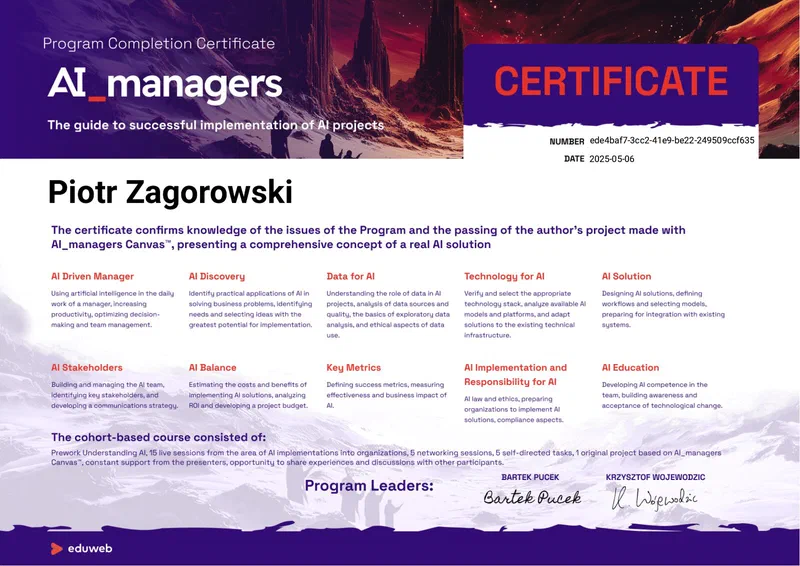
| AI Managers | Cohort programme by eduweb, led by Bartek Pucek and Krzysztof Wojewodzic, in Polish |
| Completed | Career Essentials: August 2023. AI Managers: May 2025 |
Start with the vocabulary: Career Essentials in Generative AI
When I took it in 2023, the path was five short courses:
- What Is Generative AI? by Pinar Seyhan Demirdag
- Generative AI: The Evolution of Thoughtful Online Search by Ashley Kennedy
- Streamlining Your Work with Microsoft Bing Chat by Jess Stratton
- Ethics in the Age of Generative AI by Vilas Dhar
- Introduction to Artificial Intelligence by Doug Rose
It won’t make you an expert. It will let you follow the conversation in a meeting about AI and ask better questions. That was enough to make me want more.
The part I still use is the ethics course. My takeaways from it:
- Ethics in AI is a human responsibility. AI systems can’t manage it on their own.
- Vilas Dhar’s three-pillar framework is a simple way to look at an ethical concern in generative AI before you act on it.
- Preparing an organisation means equipping three groups to make ethical decisions and manage AI risk: the technology teams, the leadership team and the board.
- Listening to customers, and communicating clearly across the organisation, is what makes an AI rollout responsible.
The path today
LinkedIn has since rebuilt the path. Only the ethics course carried over. Today it includes Generative AI: From Prompts to Partnership (Jeremy Utley), Everyday AI Concepts (Doug Rose), The GenAI Prompt Playbook, Your Top AI Questions Answered: AI Literacy for Everyone (Dr Marily Nika), Learning Microsoft 365 Copilot for Work (Jess Stratton) and Ethics in the Age of Generative AI (Vilas Dhar). The names have changed, but it’s still a free-to-start way to get the basics in an afternoon or two.
AI Managers: homework before day one
We had pre-work. Homework before the programme even started. And it could have passed for a solid AI fundamentals course on its own.
The point that stayed with me came from one of the guest experts, Robert Pławiak: AI without a deep understanding of your business and your own processes is an empty shell. The programme is built around that. Small group meetups, practical assignments and a well-organised learning portal turn a firehose of content into something you can use.
Huge thanks to the creators, Krzysztof and Bartek, for putting it together, and to Pola Karpeta-Jarząbek, whose energy, moderation and responsiveness to feedback held the whole cohort together.
The canvas: picking an AI project that’s worth it
The heart of the programme is the AI_managers Canvas. Before anyone talks about models, you work through eleven boxes: the problem, the people who’ll use the result, the value, the data, the technology, the solution, the key people, the benefits, the cost, the metrics and the implementation plan. To finish the course, you fill one in for a real AI solution.
My project: predictive capacity planning in data centres
I picked a problem I know well: capacity planning in data centres. I built the case from public information as a learning exercise, not as a company project, but the problem is real across the industry.
- The problem. Capacity planning often runs on spreadsheets, each region with its own. Power, cooling and rack data sit in separate systems that don’t talk to each other. AI workloads make demand far harder to predict, and power equipment can take six to nine months to arrive. Forecast late and you miss the business; forecast high and you pay for space and power nobody uses.
- The people. A data centre manager reconciling reports by hand, an operations lead who wants to see failures coming, a sustainability officer chasing energy targets. Each got a persona with their goals, frustrations and daily routine.
- The solution. One platform that pulls the operational data together, forecasts demand over several horizons (a day, a week, a month, a year), and recommends changes to cooling, power and rack layout. A person approves each recommendation before anything changes.
- The pilot. One site, three months, every recommendation checked by hand, no change to how the teams work day to day.
It was also the first time I used AI for the whole piece of work. It did the research and the data gathering, helped me pull everything into a structure, and was the partner I talked my ideas through with. At the end it did the post-production: typos, and checking every box against the examples in the course template. The ideas and the choices were mine. The AI made it possible to do that much thinking in the time I had.
The feedback that taught me the most
The course team called it an exceptionally solid, well-thought-out project. I’m proud of that. But the most useful part of the review was the list of gaps:
- Automation bias. The more you automate, the more people accept the AI’s recommendation without questioning it. That’s a leadership problem, not a technical one.
- Drift. Data and demand patterns change, and I had no plan for noticing when the model stops being right.
- Legacy systems. Integrating with older systems is where timelines and budgets slip. Plan for it.
- The user’s own time. I measured energy, accuracy and return on investment, but not whether the manager makes decisions faster. That’s the metric people feel.
The course also gave a short list of criteria for choosing which AI idea to start with. My summary: pick the one where the data exists, the pain is real, and someone will own the result.
Who it’s for
Managers and technical leaders who will be asked “what’s our AI plan?” and want to answer with a project rather than a slogan. Career Essentials is a good free first step. AI Managers is the serious one, and it’s in Polish.
Lessons Learned From This Coffee Journey
- AI without understanding your own processes is an empty shell.
- Fill in the canvas before you choose a tool.
- Start where the data exists and someone owns the result.
- Watch out for automation bias: a recommendation still needs someone who questions it.
- Keep learning, and turn up even when the topic feels like it belongs to someone else.
My certificates
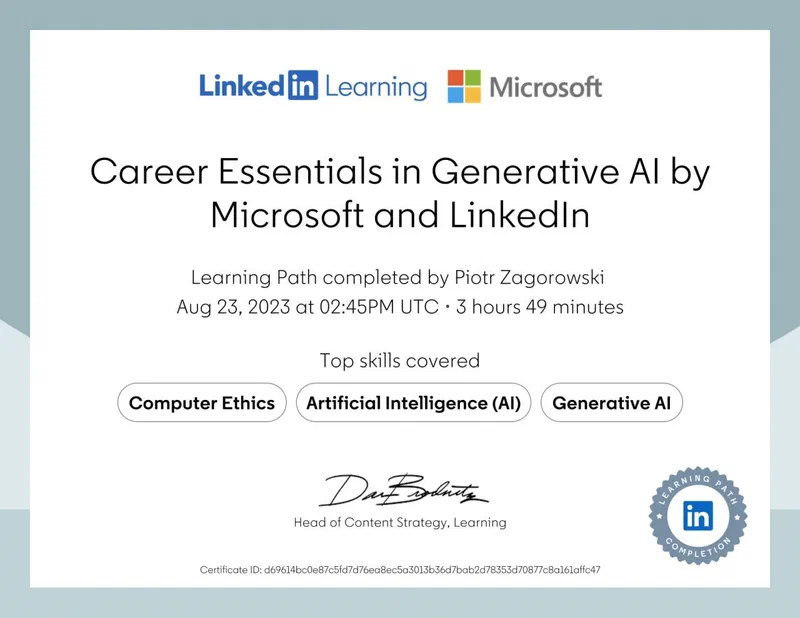
You can also verify the Career Essentials certificate on LinkedIn.
This is one of the courses I recommend for growing your career. What’s the first AI project your team should try, and has anyone written down the problem yet? Tell me.