
Contents ☕
In 2022 I went through three modules of the Adaptive Strategic Execution programme, built by Duke Corporate Education and Korn Ferry: Making Sense of Complexity, Managing Critical Relationships and Aligning Work With Strategy. It was mandatory training at work at the time. I started it as a chore and soon realised it wasn’t one of those boring courses.
I won’t retell the course. Much of it is frameworks you can find in any strategy book. What follows are the few ideas I still use, each with the moment from my own work that made it stick.
| Programme | Adaptive Strategic Execution |
| Provider | Duke Corporate Education with Korn Ferry |
| Modules I took | Making Sense of Complexity, Managing Critical Relationships, Aligning Work With Strategy |
| Credits | 1.5 continuing education credits per module |
| Completed | February to June 2022 |
A lorry driver who never was
The course opens with VUCA: volatility, uncertainty, complexity and ambiguity. It sounds like a consultant’s acronym until you remember a time it happened to you.
Years ago I was a network engineer at a small security start-up in London. I’d decided to go home to Poland. My brother ran a hostel in Kraków and had just opened a laundry business, and I’d written a business plan for a small chain of hostels. My back-up plan was to become a lorry driver. Funny enough, a reliable lorry driver was hard to find at the time.
Then one morning it was announced that a big US tech company was buying the start-up. I parked the hostels and the lorry and stayed in engineering. For the next few years nobody quite knew which part of the new company we belonged to, and I changed managers several times.
That’s VUCA from the inside. Change arrives from a direction you weren’t watching, and the old cause and effect stops working. The course’s point is that this is now the normal state, so you need a way of working that doesn’t depend on predicting it.
Complicated is not the same as complex
The idea I use most is the difference between a complicated problem and a complex one. A complicated problem has an answer that an expert can work out. A complex one doesn’t: the answer only shows up once you start acting.
The programme used Hugh Courtney’s levels of uncertainty to decide which tools fit:
| Level | What the future looks like | What works |
|---|---|---|
| Simple | One forecast is good enough | The classic plan: from A to B |
| Complicated | A few possible outcomes | Decision analysis, options, game theory |
| Complex | A range of outcomes, none of them neutral | Scenario planning, small experiments |
| Chaotic | No basis for a forecast | Act first, look for patterns and analogies |
Most trouble I’ve seen came from treating a complex problem as merely complicated: one more analysis, one more spreadsheet, while the situation moves on. If you like this, the Cynefin framework makes the same split.
One exercise from this module is worth stealing for any stuck team: brainstorm bad ideas. Everyone writes down the most absurd fix they can think of. Each person talks through one, the others build on it, and then you ask how to turn the bad idea into a good one. It takes the fear out of the room.
When you have exhausted all possibilities, remember this: you haven’t. (Thomas Edison)
Map the people, not only the plan
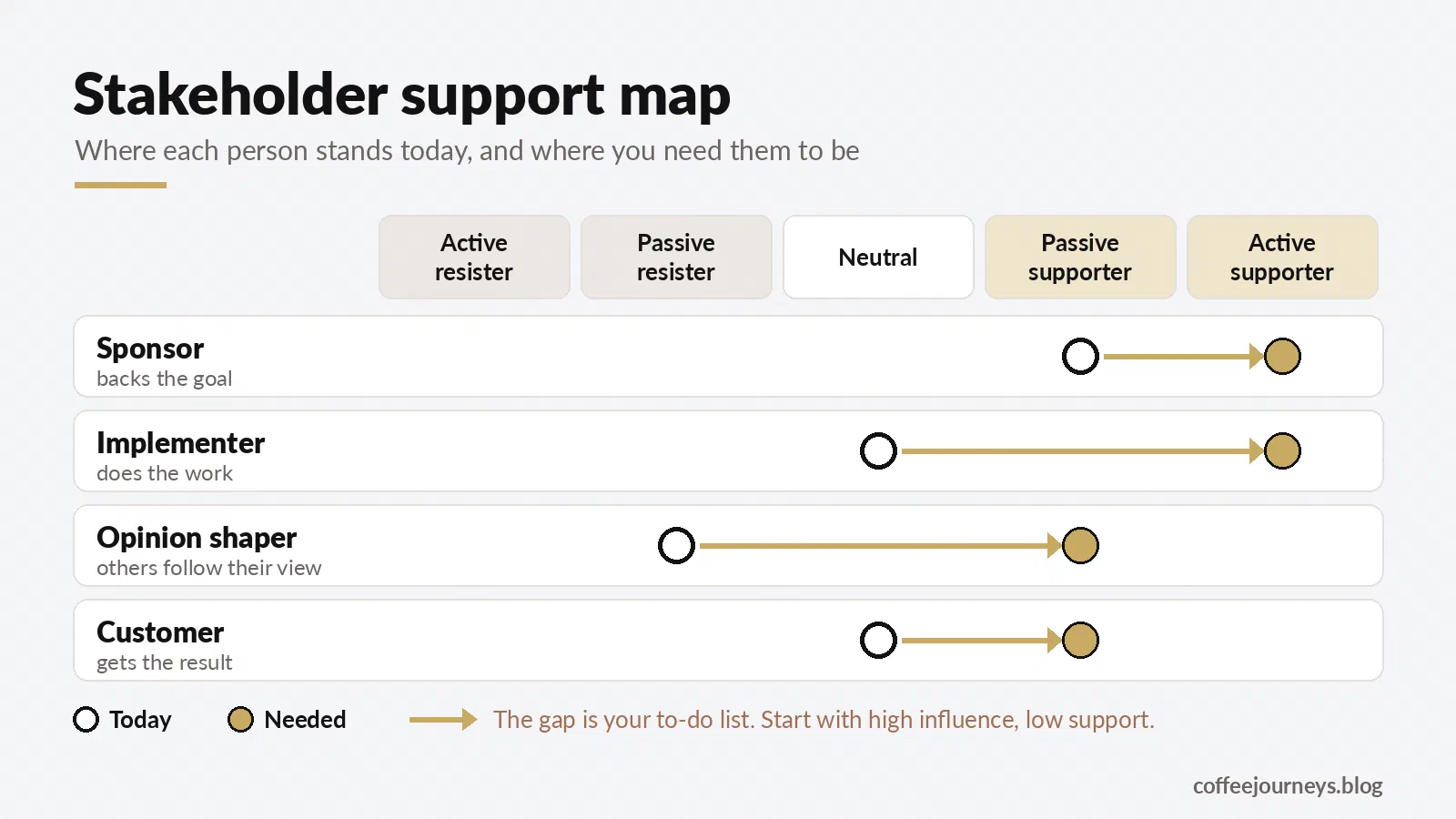
Managing Critical Relationships changed how I start any piece of work. Before the plan, I list the people. The course gives six roles:
- Sponsor: owns the challenge and backs the goal
- Implementer: does the work, and often controls the resources
- Informer: has the information the implementers need
- Customer: gets the result, inside or outside the company
- Opinion shaper: a formal or informal leader whose view others follow
- Competitor: can change the environment or how others see you
Then, for each person, two questions: where do they stand today, and where do I need them to be? The scale runs from active supporter (gives time, people and credibility) through passive supporter and neutral to passive and active resister.
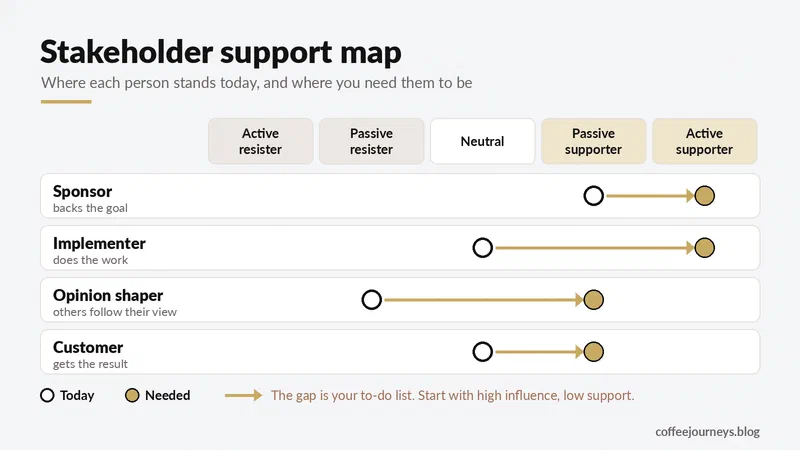
The gap between “today” and “needed” is your to-do list. I start with the people who have high influence and low support, because they’re the biggest risk. My own rule on top of the course: avoid surprises. Nobody important should hear about a problem in a meeting for the first time. I wrote more about roles in the RACI model and about early relationships in the first 90 days.
The sponsor who had my back
Of the six roles, the sponsor is the one I didn’t understand until I had one.
My first boss after the acquisition was a good man and I learnt a lot from him. He was also the boss from the old Polish joke: I’d walk into his office with my idea, and walk out with his.
Around then I read Heroic Leadership, which says everyone leads, whatever their title. So when another reorganisation left our network engineering group without a manager, I spoke up. A senior director was about to take our group on, and I told him I wanted to lead it.
He made it happen. For the first time I had one-to-ones that weren’t status reports. We talked about my growth and the team’s. It wasn’t an easy time: plenty of outages and calls with angry customers. But I knew he had our back. We planned together how to use people, how to grow the team and how to set up a new support team abroad.
A mentor gives you advice. A sponsor spends their own credibility on you, in rooms you’re not in. If you’re good at your job and still stuck, the missing piece is often a sponsor. Find the person whose goals your work serves, show them the value, and tell them plainly what you want next.
Trust has a denominator
The course borrowed the trust equation from The Trusted Advisor by Maister, Green and Galford:
Trust = (Credibility + Reliability + Integrity) ÷ Self-orientation
Everyone works on the top line. The bottom line is what catches people out: the more a conversation is about you, your bonus or your team’s credit, the less any of the top line counts. The course made it concrete with a game where teams that competed sent false signals and broke commitments, and ended up worse off than teams that cooperated.
Pick a metric that teaches the right habit
From Aligning Work With Strategy: leading indicators push people to do the right things, and lagging indicators tell you what already happened.
At the time we were running a project that needed a lot of peering at internet exchanges: connecting directly to other networks to shorten the path to them. My boss gave me a target of 1,000 peering connections, which sounded crazy. I made it an extra KPI and reported it at every chance I got. Soon the team was looking for peering opportunities without being asked, and some of them wrote automation to make each new connection easier. We reached the number and had a small celebration.
The number didn’t do that on its own. Reporting it everywhere made it matter, and because it counted something the team could act on every week, it pulled everyone the right way. It works the other way too: put “days since the last outage” on a wall, and people learn to stop reporting small incidents.
Who it’s for
People who lead project work across teams, with or without a title, and keep running into the same wall: the plan was fine, but the people and the situation weren’t. The stakeholder and complexity parts are where the value is.
You can take the modules through your employer, as I did, or in Korn Ferry’s public and virtual classes. The full programme certificate needs the two required modules (Aligning Work With Strategy and Making Sense of Complexity) plus four electives. I took the two required ones and Managing Critical Relationships, which is enough to get the ideas on this page.
Lessons Learned From This Coffee Journey
- Decide whether a problem is complicated or complex before you pick the tool.
- List the people before you write the plan, and know where each one stands.
- Avoid surprises.
- Look for a sponsor, not only a mentor.
- Trust drops as self-interest rises.
- Measure something the team can act on, and talk about it often.
My certificates
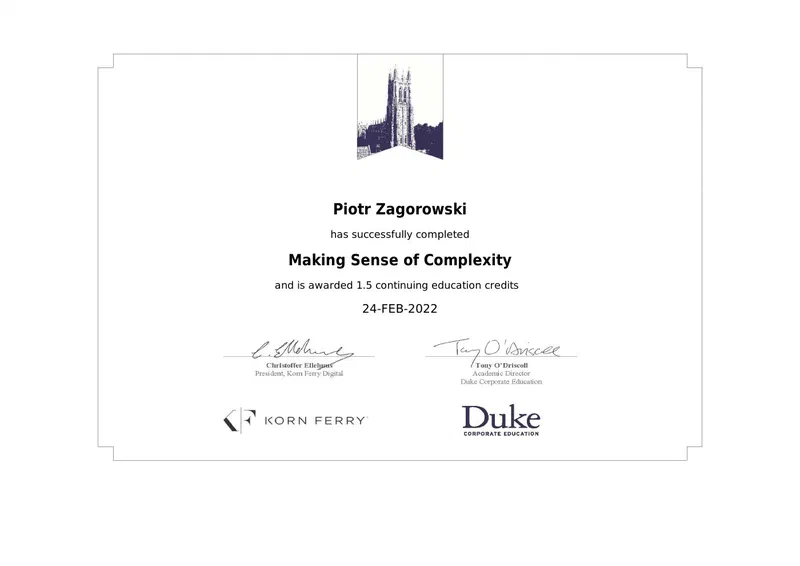
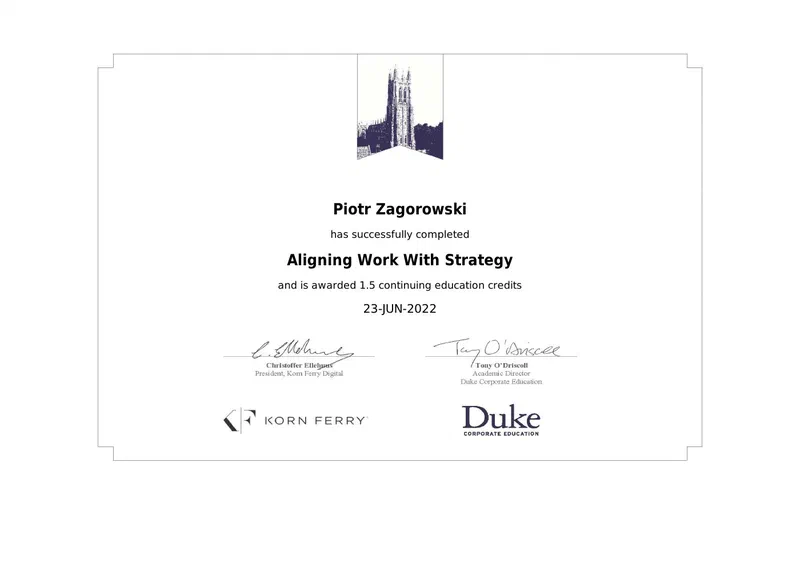
This is one of the courses I recommend for growing your career. Which have you seen at work: a complex problem treated as complicated, or a project saved by a sponsor? Tell me.